
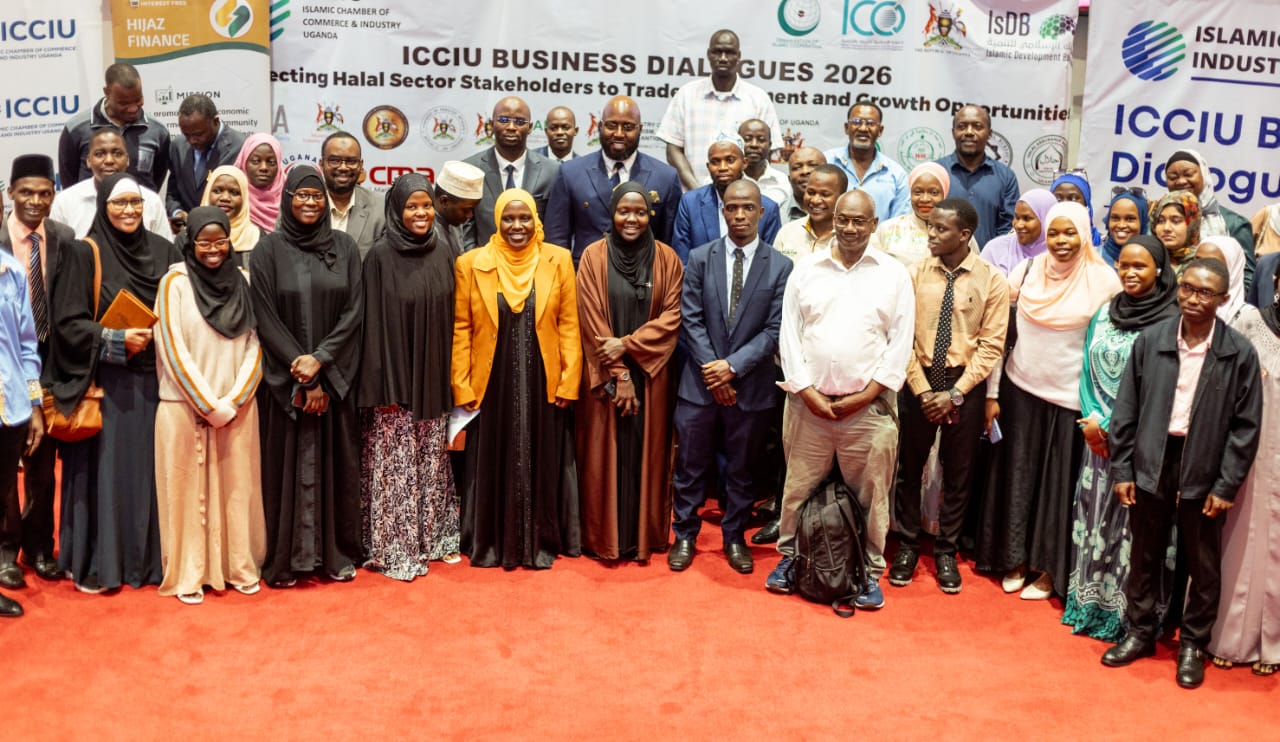
The Islamic Chamber of Commerce and Industry Uganda (ICCIU) has convened its first ever business dialogue under the theme, ‘Opportunities in the Global Halal Economy for Uganda Businesses and Economy.’
Hosted at the Uganda Investment Authority Auditorium, at the Uganda Business Facilitation Centre in Kampala, the hybrid session (online and physical), brought together academia, government MDAs, investors, and other stakeholders.
The dialogue explored how Uganda can position itself to benefit from the rapidly growing global Halal markets.
Speaking virtually, Dr. Ahmed Kaweesa, Assistant Secretary General for Economic Affairs at the Organisation of Islamic Cooperation (OIC), noted that Uganda is well placed to benefit from the expanding global Halal economy.
He pointed to Uganda’s agricultural base as a key advantage, with agro-based exports already attracting interest in international markets, particularly the Middle East. He also highlighted opportunities in tourism, logistics, fashion, and Islamic finance, as emerging sectors within the Halal value chain.
"Uganda has a real opportunity to participate in the global Halal economy because of its agricultural strengths and location. What is now required is stronger certification, better standards and coordinated development across key sectors, so that products can meet international expectations in growing markets," he said.
He also explained that Halal is increasingly understood as a broader market standard that goes beyond religious considerations. “Halal economy is a holistic system that begins with the sourcing of the right raw materials and extends throughout the production chain,” he said.
Dr. Kaweesa also observed that Uganda’s youthful population presents a strong labour and enterprise base that has the capacity to drive the sector’s growth, but stressed that unlocking this potential will depend on deliberate investment in skills, institutional coordination and a clear policy framework to connect local producers to global Halal markets.
Prof. Dr. Hadijah Nakyinsige, Senior Lecturer, Department of Food Science and Technology PhD (Food Sci & Tech, Halal Products Sci), at Kyambogo University, emphasized that Halal economy is founded on principles of justice, trust, quality, and shared prosperity.
She urged Uganda to improve its Halal services ahead of major continental events such as AFCON, noting that many visitors from Muslim-majority countries will expect Halal-compliant services. She added that Halal extends beyond food and requires a broader system of service readiness.
Drawing lessons from Qatar’s preparations for the 2022 FIFA World Cup, she highlighted how countries can create significant business opportunities by ensuring reliable Halal supply chains.
In his remarks, the ICCIU Vice President, H.E. Ismail Mpanga-Bbumba, said the event marked the beginning of a series of engagements aimed at raising awareness of the Halal economy and bringing together stakeholders from different sectors.
"Halal is not only for Muslims, because whatever is considered haram is harmful for everyone. Our focus now is to strengthen Halal accreditation and certification so that Ugandan businesses can operate confidently in the global Halal market," he said.
He reaffirmed ICCIU’s commitment to developing Uganda’s Halal sector through partnerships, awareness, and capacity building.
He noted recent progress in the ecosystem, including the launch of Salaam Bank as the country’s first Islamic bank, alongside growing activity in Islamic insurance, Halal certification for exports, and Sharia-compliant financing for SMEs and agriculture, supported by government reforms and rising demand for ethical financial services.
The global Halal economy is a rapidly expanding multi-trillion-dollar ecosystem spanning products and services compliant with Islamic law. Currently valued between $7.4 trillion and $10.9 trillion, the agenda is driven by Islamic finance, halal food, modest fashion, travel, cosmetics, and pharmaceuticals.
The overall global Halal industry represents a massive financial and consumer sector, with projections suggesting it could reach upwards of $10.9 trillion by 2028.
